 Chargeback Reply
Shopify Chargeback Response Template (With Examples by Reason Code)
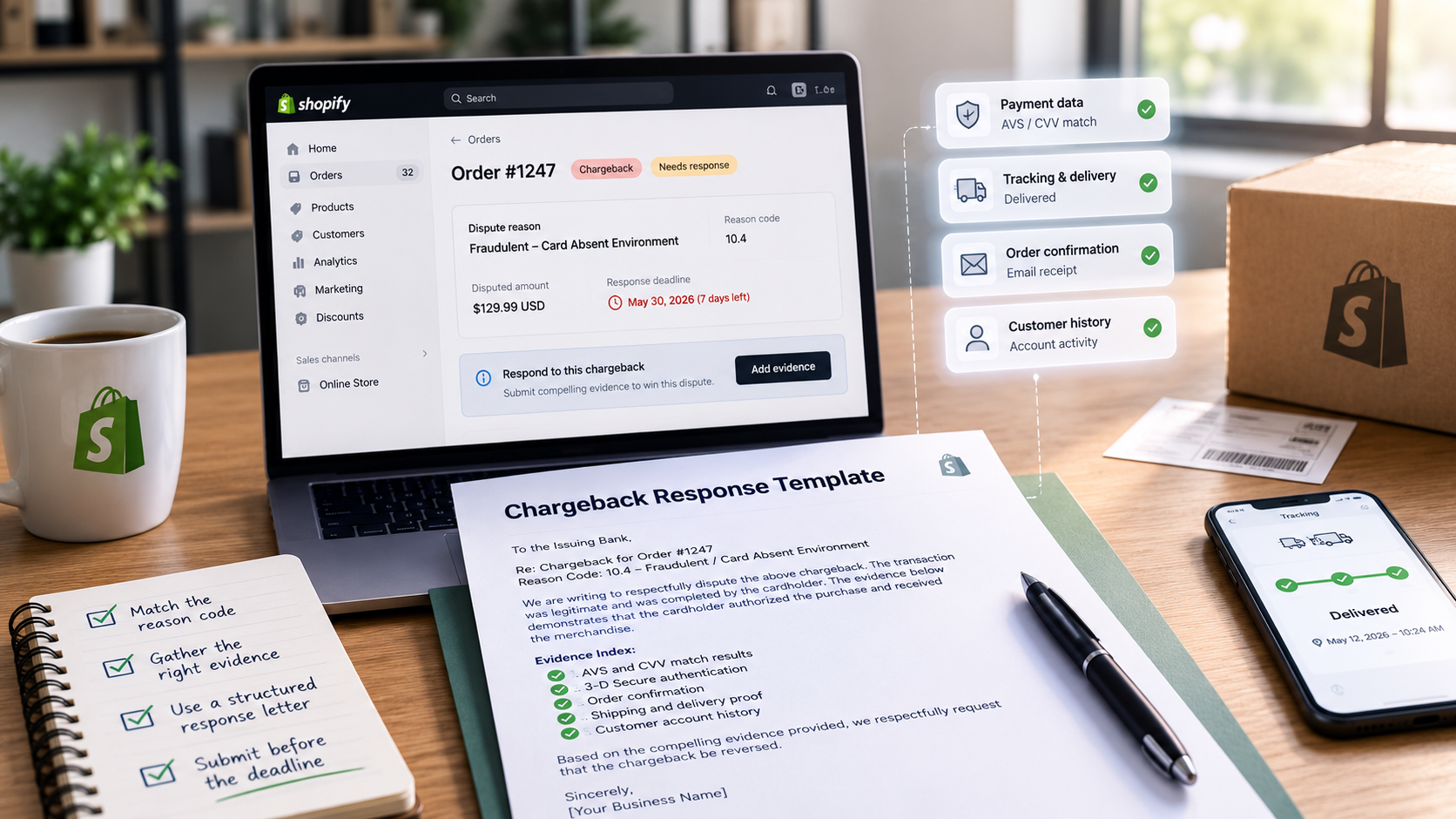
A chargeback response letter is your one written argument to the cardholder's bank explaining why the charge is valid. A good template gives you the structure banks expect; but the part that actually wins is matching your evidence to the exact reason code. This guide gives you a reusable template you can copy today, real examples adapted to each common reason code, and the difference between a letter that wins and one that loses.
Use the skeleton below as your starting point. When you want the finished, reason-code-specific version with your exhibits already organized, the generator builds it for you in a couple of minutes.
What a chargeback response letter actually is
When a customer disputes a charge, you don't argue with them, you argue with their issuing bank. Your response is a single document, a short rebuttal letter plus numbered exhibits, that you submit through your Shopify admin. Shopify forwards it to the card network; the issuing bank, not Shopify, makes the final call.
The bank reviewer has minutes, not hours. Card-network rules define what counts as compelling evidence: proof that the cardholder participated in the transaction, received the goods or services, or benefited from them. Your whole letter exists to demonstrate one of those three things as quickly and clearly as possible. For the full process from notice to decision, see our Shopify chargeback guide.
The anatomy of a letter that wins
Every winning response, regardless of reason code, is built from the same blocks. Keep it to roughly one page and let the exhibits carry the weight.
- Identifiers. Your store name and contact details, the case/dispute ID, the reason code, the order number, the transaction date, the disputed amount, and the acquirer reference number (ARN). This lets the reviewer match your letter to the case instantly.
- Opening statement. One or two sentences stating that you are contesting the chargeback and why the charge is legitimate.
- The facts. A brief, neutral account of the order: who bought what, when, and how it was fulfilled or accessed.
- The evidence, mapped to the claim. A numbered list of exhibits, each one directly answering the dispute reason.
- Policy acknowledgment. A note that the customer accepted your refund/return policy and terms at checkout, and whether they contacted you before disputing.
- Closing request. A polite, direct ask that the transaction be upheld in full.
The template (copy, then fill in)
Here is a reusable skeleton. Replace every bracketed placeholder with your real details, and delete any exhibit line that doesn't apply to your case. Never invent a fact to fill a gap, a bank that catches one fabricated detail dismisses the whole letter.
To:   [Issuing bank / dispute resolution]
From: [Store name] — [contact email] — [website]
Date: [submission date]

Re:   Rebuttal to chargeback [case / dispute ID]
Reason code:  [e.g. Visa 10.4 — Fraud, card-absent environment]
Cardholder:   [name on the order]
Order:        [order #]   Transaction date: [date]   Amount: [amount + currency]
ARN:          [acquirer reference number]

We are contesting this chargeback. The evidence below shows that the
cardholder placed and [received / benefited from] this order.

  1. [Exhibit 1 — order record with matching billing and shipping name/address]
  2. [Exhibit 2 — AVS + CVV match, and 3-D Secure result if available]
  3. [Exhibit 3 — carrier tracking showing delivery to the cardholder's address]
  4. [Exhibit 4 — prior undisputed orders from the same account / device / IP]

The customer accepted our [refund / return] policy at checkout (Exhibit [n])
and did not contact us to resolve the issue before filing this dispute.

We respectfully ask that the transaction be upheld in full.

[Store name]
That skeleton is enough to organize a response. What it can't do on its own is decide which exhibits belong in it, because that changes entirely with the reason code.
Why one template is never enough
The blocks above stay the same for every dispute. The evidence inside them does not. Answering a "fraud" claim with shipping proof, or a "not received" claim with card-verification data, is an automatic loss, because neither one answers the question the bank is actually asking. A generic, one-size letter reads as boilerplate and loses to a targeted one nearly every time.
So think of it as one skeleton with interchangeable evidence. Below are the four most common Shopify reason codes and the specific exhibits that win each. For a deeper library of what to attach, see our chargeback evidence guide.
Response examples by reason code
Fraud / "I didn't authorize this" (Visa 10.4)
The cardholder claims they never made the purchase, the classic friendly fraud scenario. You win by proving the real cardholder was behind the order.
What to put in the exhibits: AVS and CVV match results; 3-D Secure / SCA authentication if it was used; carrier tracking with delivery to the cardholder's address; and account, login, and IP history tying the order to the customer.
Reason code 10.4 is also eligible for Visa Compelling Evidence 3.0 (CE 3.0). If you can show two prior undisputed transactions from the same customer, each between 120 and 365 days before the dispute, that share at least two data points with the disputed order, from IP address, device ID/fingerprint, login/user ID, or shipping address, with at least one being the IP or device ID, the dispute can be reversed on that basis alone.
Example opening line: "This order passed AVS and CVV verification (Exhibit 2), was authenticated via 3-D Secure (Exhibit 3), and shipped to the cardholder's verified address (Exhibit 4). Two prior undisputed orders from the same account and device are attached (Exhibit 5)."
Product not received (Visa 13.1)
The customer says the order never arrived. You win with proof of delivery.
What to put in the exhibits: the carrier tracking number and proof of delivery (signature or delivery confirmation), the shipping notification sent to the customer, and confirmation that the delivery address matches the one on the order.
Example opening line: "Tracking number [X] shows this order was delivered to the cardholder's address on [date], confirmed by [carrier] (Exhibit 1). The delivery address matches the billing address on file (Exhibit 2)."
Not as described or defective (Visa 13.3)
The customer disputes the item's condition or description. You win by showing the product matched its listing and that your policy was available.
What to put in the exhibits: the product page exactly as it appeared at purchase, your return and refund policy as shown at checkout, and any customer communications showing the issue was addressed, or never raised with you at all.
Example opening line: "The item was delivered as described on the product page (Exhibit 1). Our return policy was presented at checkout (Exhibit 2), and the customer did not contact us or request a return before disputing (Exhibit 3)."
Subscription / recurring charge (Visa 13.2)
The customer says they cancelled, or never agreed to recurring billing. You win by proving the opt-in and continued use.
What to put in the exhibits: the signed or logged opt-in to recurring billing, your cancellation terms as presented, and usage or access logs showing the service was used after the disputed renewal.
Example opening line: "The customer opted in to recurring billing on [date] (Exhibit 1) and accessed the service on [dates] after the disputed charge (Exhibit 2). No cancellation request was received before the renewal (Exhibit 3)."
What separates a winning letter from a losing one
The same case can win or lose on execution alone. Winners do this:
- Match the exact reason code. Every exhibit answers the specific claim, nothing generic.
- Lead with evidence, not emotion. Banks weigh facts and documents, not frustration. Keep the tone neutral and professional.
- Back every claim with an exhibit. If you assert delivery, attach the tracking. An unsupported sentence counts for nothing.
- Number and label the exhibits. A reviewer skimming for two minutes should find each proof instantly.
- Stay to one page. A tight letter with clear exhibits beats a three-page narrative.
- Never invent anything. No guessed dates, no edited screenshots. One fabrication discredits the entire response.
Losers do the opposite: a generic template, a single unbroken paragraph, the wrong evidence for the code, or, most common of all, a submission that misses the deadline.
Format and how to submit on Shopify
Presentation is part of the rules, not an afterthought.
- File format: the networks accept PDF or JPEG. Combine your letter and exhibits into one clean, legible file.
- File size: keep it lean, Visa allows only about 2 MB of evidence, so compress large screenshots rather than dumping raw images.
- One page for the letter, with the exhibits attached after it and referenced by number.
- Submit in your Shopify admin before the due date shown on the order. Shopify's response window is typically 7 to 21 days, which is tighter than the card network's own timeline, so the Shopify deadline is the one that matters. Submit early; nothing can be changed after it closes.
Let the generator build your version
This template gives you the skeleton. The hard part, knowing which exhibits win your specific reason code, arranging them in the order a bank expects, and doing it before a tight deadline, is exactly what Chargeback Reply automates.
You answer a short guided form, it matches your reason code to the winning evidence, scores your case so you know where it stands, and generates a complete, bank-ready response letter with your exhibits organized and formatted to Shopify's submission rules.
Frequently asked questions
What does a good chargeback response letter look like?
It's about one page: your store and case identifiers (reason code, dispute ID, ARN, amount), a one-line statement that you're contesting the charge, a brief account of the order, and a numbered list of exhibits that each answer the dispute reason. Evidence carries the argument, not emotion.
Do you need a different response letter for each reason code?
The structure stays the same, but the evidence must change with the reason code. A fraud claim (Visa 10.4) needs verification and prior-transaction data, while a "not received" claim (13.1) needs proof of delivery. Sending the wrong evidence for the code is an automatic loss.
Can I reuse a generic chargeback template?
You can reuse the skeleton, but not the content. A generic letter that isn't matched to your exact reason code reads as boilerplate and loses to a targeted response. Use the template for structure, then fill it with the specific exhibits that win your code.
Sources
This article is general information, not legal advice. The final decision on any dispute rests with the issuing bank.